Anybody Home?: TorahCycle Pekudei

Toldot

When I was in high school, my father, much to my chagrin, began answering the phone saying Nobody home!, mostly in jest but also implying prospective friends or dates too flummoxed or intimidated were people with whom I should not socialize. (This the same guy who, invited to a boring relative’s three months out, intoned gravely I’m sorry, I have a funeral.)

These days when we say Nobody home, we’re usually referring to what we politely call a “senior moment,” a confusion/absence of facts or names, one or many synapses misfiring. We’re so in the moment we can’t add more to it, or so “out to lunch” we can’t cope with what’s already on our plate.

So how do you know if there’s somebody home or not?

In this reading we’re told “HaShem’s glory” descended to fill the mishkan and will hover over it in a cloud as a sign of God’s presence. If the cloud rises in the morning, time to pack up and get shlepping. If the cloud remains low, a day to stay put. HaShem will also keep a fire burning in the mishkan each night.

Hearth fires give security. Very different than being out in the dark wondering what’s too near, eying us with predatory intent. The fire mean’s God’s home and with you. No matter what’s circling, you can feel safe and protected, if you believe HaShem is home.

How can we know as clearly when we’re really present? Having our brains respond accurately is a good start. Other parts showing up help too. If we’re talking I might hear your words. But that doesn’t guarantee I really understand you, or that I’m ready to help. I may hear that you need something, but unless I open my hands, my wallet, or my heart, you might think nobody’s home.

So if we’re not always fully present—for whatever reasons–why would we assume the divine presence is always on tap? Cloud, schmoud! Couldn’t it be smoke and mirrors?

Q: How do you know anyone’s really home in the mishkan?
A: It’s partly a matter of faith. But if you’re not at home in you, it won’t much matter.

More answer: To live with greater awareness and intention, you have to be home in yourself, regardless of what/who is outside you. You need a strong center, though not one that’s housed in too strong an ego. You should be at least as receptive as you are active. Working on your karmic homework while listening for the help that’s offered you regularly.

How? To really connect with HaShem, not just sidle up to the reassuring presence of the fire or the cloud, you have to really be home in your inner mishkan. You need to listen with your heart and soul as well as with your ears. If you’re thinking too much about your t-shirt dyed pink in the wash, you’re unlikely to hear divine insights, even if they’re telling you how to bleach it–or your soul–white again.

Final answer: If you’re at home with you, HaShem is too.
Making My Mishkan: TorahCycle Vayakhel

Class - Post

Much of this week’s reading is about the making of the mishkan, the portable ark, and the accoutrements for its assembly and use. I’ve spent the past several weeks working on a different sort of mishkan, the workbook for a class/process I’m developing. I’m loving the chance to re-encounter Jewish mysticism and to express my take on Kabbalah, the system of insight that’s become the spine of my spiritual journey.

Our spirituality is deeply individual. We may share holidays or prayers, language or metaphors, a belief in what’s eternal. But at its heart, spirituality is a conversation you have most often with yourself, and with the world of the unseen, however and wherever you encounter it.

The mishkan is a receptor site. A place to encounter the world of the unseen in space-time.

Some folks get that sense of connection in services or ritual. I find it most often through writing. In the magical connection between words and synapses. Images and ideas than run through me, teach me, help me talk to others.

I hope you find this place, because there’s few feelings as good as being connected with a wisdom greater than one’s own.

Developing this course is pushing me to go face-to-face with my beliefs and practices. Just as the ice storm that disconnected me from the internet for days left me grateful for my wood stove, I’m distilling what really matters. What’s necessary and core. What gives nourishment. When it’s incredible joy, it’s rewarding from soul to gut. I hope the same for you, however you get there.

I’m working through images and practices that connect us with our highest selves, and that help us examine why our less noble parts sometimes grab the wheel. I’m trying to express these concepts in ways that feel accessible and whole. As I do, I’m struck again by the importance of sharing our best with one another. For me, that’s writing and problem solving. For someone else it might be singing or carpentry.

We’re a community. Each one of us part of a whole trying to express itself through the imperfect instruments that we are. Our job is to listen well, and then do our best to give our best. Together we make a mishkan, a place to receive the holy and to heal this imperfect world.

We may have snarky days, or clumsy ones. No one can be sacred and in a good mood all the time. No email, phone, and FaceBook made me cranky as well as giving me time to write.

Being human means we need lots of slowing and quieting down to hear what we’re supposed to. Turning down outer noise, albeit not by choice, brought all the blessings of any great vacation or extended Shabbat. A chance for reflection, for hearing the universe tell me more than I often try to ask or tell it. Visiting the mishkan of greater quietude.

By being in your own mishkan you’ll hear what you most need. Let what comes through open and teach you. However you find your mishkan, I hope you’ll visit often and receive much.

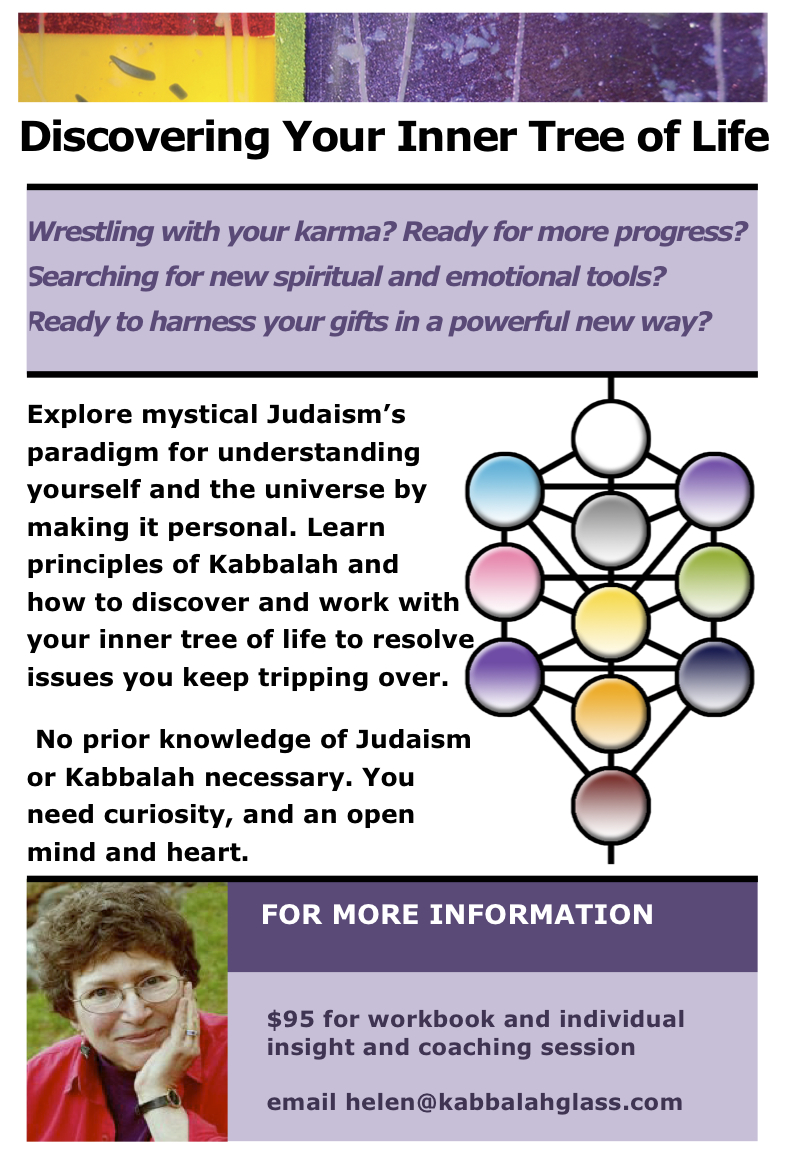
PS – If Discovering Your Inner Tree of Life sounds interesting, please let me know.

Mercy, Mercy: TorahCycle Ki Tisa

Vayeira 2013Have you ever done something so bad you thought you’d never be forgiven? Not a small thing, but something you thought, maybe even swore, you’d never do?

That’s what the Israelites do this week, while waiting for Moses to descend Sinai. They get impatient, worry he might not come back. They violate the No other gods commandment, and smelt their gold into a golden calf. It’s not as small as Don’t think about X and then doing so obsessively. But it’s a helluva lot more than We were restless. Hard to stay calm when your mind keeps chewing over  the insufficient calming of Don’t worry. Be patient..

I just finished two books about guilt and shame. About actions taken which dominate the lives of the people who did them. Both Donna Tartt’s The Goldfinch and Jhumpa Lahiri’s The Lowlands are good reads, though it’s tough living inside the heads and hearts of people in chronic emotional pain. Each needs to find a road to redemption. A way to start over is lots harder and more important than dialing up a pizza or a Netflixx movie.

It means finding and accepting forgiveness. In this story it’s gonna take a coupla generations and forty years of schlepping. A road, a long one, to the promised land. Moses, pleading for them, gets HaShem to say yes to coming along as witness, guide, protector.

Interestingly this same reading includes the thirteen attributes of mercy  (rachamim in Hebrew, a lovely sounding word), including compassion, mercy, graciousness, truth, forgiveness, and pardon.

Imagine if those qualities organized your life, your head, and your heart. Imagine a world slow to anger. Imagine yourself slow to anger.

When Moses returns, his face is so touched with holy light that the people, albeit guilty and ashamed, cannot look directly at him. His face also gets red with wrath as he breaks the tablets.

There was a great NPR riff the other day (though it may have been on Bluff the Listener) about an app that lets you see what someone else sees when they’re watching you. How you look when flushed with joy, red with anger, or blushing in shame. A chance to witness yourself as others see you.

My family didn’t do anger with sound. Instead people retreated to their corner with a book. No eye contact. The app would not have shown their inner turmoil, that churning of anxiety, guilt, and fear of future consequences, even if apologies were said and officially accepted.

External forgiveness is great. But it doesn’t really take hold until you forgive yourself. Imagine extending the thirteen qualities of mercy towards yourself. Imagine being able to bathe in them, wash clean your bad choices and your mistakes. Whatever you said or did not undone but cleared of its power to influence your next forty years. Imagine mercy that releases their hold on your heart.

It takes time for a new equilibrium to settle in. We’ve all learned from our personal shlepping that the road is rarely smooth and level. There are always more tests, reality checks large and small, to test our resolve. But if we let mercy in, and our commitment to change is strong, we can move from this now to a better next.

Put On Your Robes: TorahCycle Tetzaveh

Tetzaveh 2014

This week’s reading has very detailed instructions about priestly vestments. Think special in the way of prom and wedding dresses. Clothes we wear for high occasions, for initiations, and that ready the wearer for ritual. In this case, white linens and a jeweled breastplate, and rituals of atonement and renewal.

Torah names a select few, and one High Priest, as initiated and elevated. In my cosmology, humanity is a nation of priests, each for another.

Some days I can see my robes and on other days yours. When it’s yours, I transcend knowing you don them on one arm at a time, just like I do. Instead I listen up, and can hear deeper truths from you about how I’m off-track and screwing up, or doing well, making good choices. I credit your stories with more authority.

Most problems in life come when my non-robe-wearing self butts into your non-rob-wearing self. If we could remember who we really are, we’d be less easily annoyed and frustrated by what’s said. We’d listen better and argue less. We’d tell stories of friendship, growth, and hope.

There’re days when you feel like a priest and days when you don’t. Days (or at least moments) when you walk around glowing with wow. Others when you’re cranky and nothing helps, no matter what you’re wearing. In those moments what I most need—and can seem furthest away–is to laugh. Or at least a good story.

Neil Gaimon’s sequel to American Gods dramatizes the transition from gods whose stories were tales of carnage, red in tooth and claw, to the rise of trickster gods and clever heroes. Gods who teach by making us think. The God of Torah is yet another evolution: a god whose stories open our consciousness and our hearts. Who helps us out of stuck. Who readies us to elevate both our stories and our souls.

Good priests do that too. Beyond conducting a great ritual, they invite you to see yourself in a clearer light: to witness, accept, and ask for more insight–from yourself and others, from holy messengers in every form. They bring you closer to the holiness inside and around you. They help you make more moments of your life feel sacred, or at least better.

The stories we tell matter. They make us priestly or competitive, feel holy or provoked. Because thought is the greatest trickster god of all. A thought can make you hungry or sad, satisfied or victorious. It’s all in how you tell your stories, and the rituals you conduct to reinforce them. Why choose anger when you could choose love?

Try to be and see the priest in yourself and others, even wearing jeans and an old t-shirt. Even in your nemesis or the guy asking for handouts. It’s harder, and usually we don’t. More often we judge our own or others’ distance from the very holiness we profess to aspire to. Each time we do, we fail an initiation.

Putting on your robes lets you access your wisdom and experience. Lets you leave stories of hurt, cynicism, and doubt in your past. And gives you new stories of love and hope.