On the Road Again: TorahCycle Bamidbar

vayetze 2013We’re used to measuring. We experience both excess and scarcity, but tend to think more of good things will make us happier and help dim the annoyances of daily life. That’s true about love, but when we feed our lust for chocolate, drugs, and other cravings, less would be a better path.

We count our lives in days and years, though the things we remember best are moments: the first bite, not the twentieth. We measure by future events that may never happen, and from past ones that may be old baggage it’s time to set by the side of the road.

How do we decide what’s the right road, and what to bring along? What does experience teach us, and what’re we still struggling to learn? What’s buried in the creases of those old maps we keep folding and unfolding, trying to find our way?

When I was a kid, my wise mother had a simple dessert rule: one cuts, the other chooses. So much energy to get the bigger piece of cake, when learning to skip sugar would’ve been the better lesson.

How do we change? Are behavior and identity fixed? I’d like to think not, though believe we’re each in this wilderness to experience unique lessons, ones that are built into our karmic DNA. We are capable of learning them. Even my auto-correct (as befouled as it sometimes make things), has acquired an elegant mystical vocabulary through repeated word use. Maybe we too can grow, albeit slowly.

In ancient tribes roles were assigned, and fixed for life. Do your family of origin stories still define you? If not, how do you find or make your own tribe?

In Alice Hoffman’s new novel The Museum of Extraordinary Things, the two central characters make their way in a dark world. Each carries serious burdens, complicated by complex feelings for family, mentors, and friends. It’s a fascinating, sad, and ultimately redemptive book that navigates a landscape of incredible beauty and harshness in early 20th-century America. Hoffman raises important questions about what separates us and what pulls us towards one another.

Who are your inner tribes? If you took a census, as this week’s reading does, what parts of you would guard the innermost sanctuary and which would be on the fringes? Are you more often fierce or holy, impetuous or wise? Who are you to yourself, and who to others? How much do you share, and what do you keep hidden away? Why?

This journey is all about becoming. We are at the beginning of book four. Bamidbar. In the wilderness. What better time and place to figure out who you are and who you are becoming.

I just turned 65. Cheers for aging and wisdom. Sighs for creaky knees, and the sins of youth come home to roost. This is still a long road, I hope, learning lessons all the time. The more we trek through these passages, the more familiar the wilderness becomes. It’s never the same journey one day to the next. Our job is to keep putting one foot in front of the other, learning ourselves along the way.

Look What’s Coming: TorahCycle Emor

Emor 2014We talk about living in the eternal now. But anticipation adds spice to life. It’s exciting having something to look forward to. It’s good to know where you are in the immediate now of space/time. But it’s also useful, fun, and motivating to have nouns and verbs to describe the nows of the future. Their possibilities help keep us open, help us remember that more joy is possible, and help us prepare for the us we’re striving to become.

We tend to measure by what’s already happened, because even for the imaginative it’s harder to count backwards from a future we can’t predict with nuanced detail. But we’re complicated matrices of memories and habits, rituals and desires. We’re hardwired to anticipate events like birthdays and holidays, just like we tend to dig in our heels before work deadlines or dentist appointments. It’s physical as much as mental: If I say “long weekend,” your cells immediately fire up and smile; your pulse shifts up a gear, hoping for fun and relaxation.

This reading details the annual “callings of holiness.” It lays out weekly and annual cycles for being spiritually present. More than 130 days of the 365 are identified as times for various combinations of celebration, prayer, fasting, ritual, contemplation, atonement, study, making love, and giving thanks.

Economists generally use one-third of income as a benchmark for home/utility expenses. Imagine if you actually spent a third of your life in the habits and rituals of holiness. Not in a haphazard, grab-the-moment, isn’t-that-an-insightful/inspirational post or video kind of way. But in the committed, focused, sincere practice of goodness.

Studies repeatedly affirm that people with daily meditation practices are less anxious, more creative, and more compassionate. This reading outlines an annualized calendar for shifting focus from the simple daily palette of breath in and out to more complex patterns of observance.

Holidays and festivals break up the routines of our lives. They offer us chances to say thanks or ask for help in different ways. Prayer and gratitude in their many varietal forms.

I love reading Anne Lamott. She captures the essence of our relationship with the divine simply and honestly. If I could be the karmic love child of Anne and Rumi, I’d have my perfect writer’s pedigree. If you haven’t read Help, Thanks, Wow! and Stitches, buy or borrow them. They nicely summarize the importance of finding mean, hope, and repair, and using various forms of prayer as the punctuation marks of life.

That’s what the big calendar days do for us, whether we celebrate them with fireworks or shofar blasts. They help us affirm that in this now, we are witness to one another’s joy, suffering, striving, and triumphs. They help lift the daily weight off our shoulders, and reaffirm the value of silent prayer and singing songs that get in your head like cosmic earworms, humming your various chakras into time with cosmic rhythms.

Take a moment to mark your calendar with the big days coming up, from the personal to the societal, the spiritual to the familial. Mark them out the way you might an upcoming vacation. See how much depth, joy, and insight awaits you. I hope it makes you smile in anticipation.

Making My Mishkan: TorahCycle Vayakhel

Class - Post

Much of this week’s reading is about the making of the mishkan, the portable ark, and the accoutrements for its assembly and use. I’ve spent the past several weeks working on a different sort of mishkan, the workbook for a class/process I’m developing. I’m loving the chance to re-encounter Jewish mysticism and to express my take on Kabbalah, the system of insight that’s become the spine of my spiritual journey.

Our spirituality is deeply individual. We may share holidays or prayers, language or metaphors, a belief in what’s eternal. But at its heart, spirituality is a conversation you have most often with yourself, and with the world of the unseen, however and wherever you encounter it.

The mishkan is a receptor site. A place to encounter the world of the unseen in space-time.

Some folks get that sense of connection in services or ritual. I find it most often through writing. In the magical connection between words and synapses. Images and ideas than run through me, teach me, help me talk to others.

I hope you find this place, because there’s few feelings as good as being connected with a wisdom greater than one’s own.

Developing this course is pushing me to go face-to-face with my beliefs and practices. Just as the ice storm that disconnected me from the internet for days left me grateful for my wood stove, I’m distilling what really matters. What’s necessary and core. What gives nourishment. When it’s incredible joy, it’s rewarding from soul to gut. I hope the same for you, however you get there.

I’m working through images and practices that connect us with our highest selves, and that help us examine why our less noble parts sometimes grab the wheel. I’m trying to express these concepts in ways that feel accessible and whole. As I do, I’m struck again by the importance of sharing our best with one another. For me, that’s writing and problem solving. For someone else it might be singing or carpentry.

We’re a community. Each one of us part of a whole trying to express itself through the imperfect instruments that we are. Our job is to listen well, and then do our best to give our best. Together we make a mishkan, a place to receive the holy and to heal this imperfect world.

We may have snarky days, or clumsy ones. No one can be sacred and in a good mood all the time. No email, phone, and FaceBook made me cranky as well as giving me time to write.

Being human means we need lots of slowing and quieting down to hear what we’re supposed to. Turning down outer noise, albeit not by choice, brought all the blessings of any great vacation or extended Shabbat. A chance for reflection, for hearing the universe tell me more than I often try to ask or tell it. Visiting the mishkan of greater quietude.

By being in your own mishkan you’ll hear what you most need. Let what comes through open and teach you. However you find your mishkan, I hope you’ll visit often and receive much.

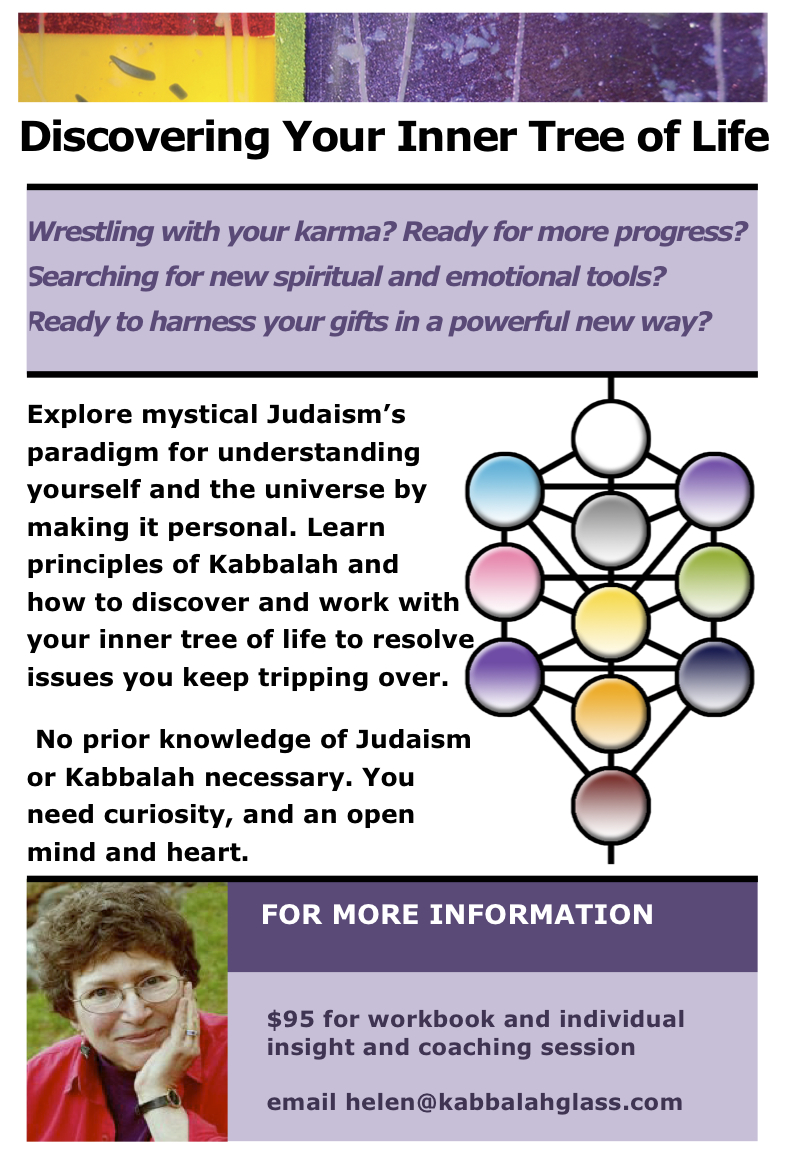
PS – If Discovering Your Inner Tree of Life sounds interesting, please let me know.

Home Base: TorahCycle Terumah

Terumah 2014A lot of my spirituality comes from the idea of being told. Of instructions about everything from my karmic homework to where I put my glasses. Messages that come with a deep sense of knowing: a synchronous recognition in my head, heart, and gut. Like the puzzle piece that slides perfectly into place, it’s an awareness of direction and action that just feels right, even if sometimes it also seems challenging, or ironically simplistic. Of course I need to be listening to hear it.

Most of us get instructions for from context. From family, teachers, partners, and mentors. Verbal and nonverbal. (Insert the classic image of my mother pulling her shoulders back and square like a drill sergeant, hissing Stand up straight!) Sometimes we listen and sometimes we don’t, to our benefit or peril.

The reading’s about the construction of the miskhkan, the portable ark the Jews will carry through the desert. It acts as home base. A place for people to gather and listen, and for HaShem to communicate with them. Such a fascinating contradiction between the core idea of indwelling spirit (our holy spark) and the need for a special site for God to visit and instruct.

I recognize and respect sacred spaces, from the comforting hush of formal sanctuaries to the hidden magic of ancient painted caves. But I prefer the idea of a portable sanctuary that’s in me. A beacon emitting the Help me, Teach me, Thank you signal the way the SETI Project sends earthly transmissions to whoever’s out there listening.

My word for that inner mishkan is HaMakom, a God-name that means The Place. Completely portable. Where the inner and outer rest within one another. HaMakom can occur anywhere in space-time. In nature or dreamtime, meditation or inspiration. It’s a conversation between worlds seen and unseen that feels just right.

No one yet knows how long they’re gonna be on the road. Making something together is a bonding exercise. Everyone contributes: money, ideas, thread.

The idea that you could make a place to invite the divine to show up is seductive. The instructions, like Noah’s ark, are many and specific. Part of the message: it takes work and time to get where you wanna go. Lots of steps. Collecting. Measuring. Assembling. Blessing. But like the old cartoon about the seeker parked outside a guru’s cave, just because you show up and ask, doesn’t mean you’ll hear anything

Atop the mishkan are two cherubs. They face one another, with a space between them. When I first heard Charlie Hayden/Pat Metheny’s album, Beyond A Missouri Sky, I was fascinated by the openness between the notes. A breath. Like an open heart, that space is our inner mishkan, our receptor site to get spoken to.

There’s lots of instructions coming. For now they’re delivered without recriminations and scolding. We’re encouraged to do good and well. Offered hope in the possibility of progress. Even its inevitability, if we listen well and choose a righteous path with an open heart.

Create HaMakom by honoring your inner mishkan. Stay open and listen well. The more you do, the better you’ll hear the answers you seek.

The Other Side: TorahCycle Beshellach

Beshellach

Sometimes you feel like you’re leaping towards liberation and other times the pace is glacial. But all roads lead to the sea, a metaphor of the last barrier which must be crossed, though the path ahead has vanished.

The story goes that everyone was standing on the edge, unsure and afraid, an angry army getting closer, until one guy jumps in. Only when the water hit his nostrils did the sea part.

That’s how ready and committed you need to be.

They emerge into a place called the Sea of Reeds. Still a sea, but with some purchase underfoot. Things returning to scale instead of a colossal tsunami on either side. And the reality of entering a new world. A new land, where everything’s unknown, both the gifts and the challenges. How nicely prophetic for the turn of the year.

Perhaps you too have made a shift in your life. Maybe not as big as getting out of slavery, but in your world just as important. Hooray if it was conscious. Even if not, think about where you were last year this time. And when you’d like to be next January. Find the vision you’ll need.

Mystical Judaism has the image/idea of klipot. Layers with which our holy spark gets covered and obscured. Think coats of pain that accrue from all your actions of denial and confusion, hesitancy or mistakes. They keep you just disconnected enough from your holiness that it can feel a little out of reach.

Now’s different. The turn of the year seems to peel away a few layers. Like you just had a loofa scrub. A little red and tender. But definitely refreshed and invigorated.

On the other side we’re like newborns. Full of potential, with our freedom, our spark, and our hope.

Take a minute to let the idea of “the other side” sink in. Big or small, you’ve made changes and committed to more. Your holy spark’s a bright ember. How’re you going to keep it glowing brightly?

What do the Israelites do on the other side? They dance and sing.

I’ve been listening to playlists put together by wise and knowing friends. One spins a beautiful refrain: What shall we do, what shall we do, with all this fragile beauty?

That’s the song of now. To decide what to do with your hard-won and fragile beauty. You can sign songs of triumph or songs of new desire. But also sing songs of hope and of commitment. Blow on your holy spark with a sure and encouraging breath. A breath of appreciation for past courage and of trust in your future.

There are moments in life when time slows. When we can get the perspective we need to move forward. That this reading comes at the time of light’s return is no accident. It encourages continuing work on our process. Asks us to look into the eye of God and then back at ourselves. To see and use our inner spark to light the way.

Whether you got here fast or slow, take a good look around. Remember this place of joy and possibility. Carry it with you as you embrace your next challenges.

Second Chances: TorahCycle Noach

Noach 2013There’s a great health prayer that gives gratitude for body parts appropriately open and flowing or closed and contained. It’s really about sufficiency and balance, the harmony of a smoothly functioning system. Excess or blockage can create chaos, as we’re told happened after creation, with generalized self-serving corruption.

Some excesses, large or small, are a source of joy. Falling in love. A beautiful day. Sublime music. A clean house and a good book. Heading out for an adventure.

But highs are often countered by lows. Being dumped. Traffic jams or flat tires. Leaky roofs. Not enough of whatever you think you need to be happy.

This week’s reading’s about what happens after excess. A total reset. Wiping the creation slate clean and starting over. When it happens to you, it’s easy to feel like the folks in the post-Katrina or –Sandy pictures. The forlorn survivors, standing in matchsticks of rubble, as far as the eye can see. Few volunteers to be that poster child.

Our lives are rarely one smooth arc.  We go through many cycles of joy, excess, loss, hope, and renewal. Over love, jobs, homes, births, deaths. Often much more trivial endeavors. Our lows aren’t as brutal as global devastation, but when you’re hurting and weeping, no matter the cause, it can feel that hard.

When we careen too far in one direction, we tip the balance, inviting in lessons that, if we were paying better attention, we might learn without having loss and pain come as teachers.

Chances are you’ve bumped into those lessons before. That they’re the ones, no matter how well you do with your other karmic homework, that you just can’t quite seem to get out from under.

You might see the storm clouds coming. External circumstances pushing you towards some edge. Or your own emotional patterns steering you onto the rocks. The universe is filled with hints and foreshadowing. But, if you’re not paying attention, you can get pretty wet before you find dry land again.

Most of us have good instincts about what’s important to our happiness, whether that’s body, mind, heart, or spirit. Think about the yin and the yang of what matters to you. What you’d really need to create your next world. Bring that on board. Then release what’s ready to be washed away as you enter the ark of your future.

Most of us won’t see doves bearing divine messages. But hopefully you’ll learn the markers of better decision-making and know what to do next.

At the end of the Noah story, the rainbow symbolizes the divine promise that devastation will never again be so total. Translation: once you’ve tanked, there’s nowhere to go but up. You’ve earned another chance to get it right. Another chance to get clearer about how you want to live.

Take time this week to think about the next cycle of your adventure. What do you want your life to be about? What parts do you need to shed, to say Thanks but good-bye? Which to heal and improve? To invest in, give voice, learn from? If you can contemplate the answers with more curiosity than fear, hooray for the promise of this next round.

Learning to Listen: TorahCycle Balak

BalakA guy’s hired to curse the Israelites. On the way his donkey refuses to go forward. He beats her; she says, Can’t you see the angel in the road trying to stop us ?!?

Confession: I’m a sucker for holy messengers. Usually I get advice from well-meaning friends. My typical response I’m trying!!!, even though I believe on any given day that I could be your holy messenger, and you could be mine.

How do we typically respond? After getting nasty test results, for example, we swear healthy vows. Vows we mean deeply and sincerely. In that moment. Note: we also develop robust vow-breaking muscles. So when that next plate of brownies beckons, it’s easy to go unconscious again and munch happily down the road.

Talking critters are harder to ignore. Or to sell a snow job on the path back to comfy ignorance. How can you tell if you’re listening to an angel or a charming seducer? Hint: your inner evil twin more often pushes cake than salad.

One good stalling tactic is to make do/don’t lists. Note: lists imply skepticism about the urgency of what your higher self is shouting. And then such a small step to denial. Or maybe a big one, but repeated often.

Intentions without action are easily ignored, with predictably useless results. With no sharp stick in your butt it’s easy to jog in place, swearing and breaking your vows. For a perfect recipe of stasis, add regular doses of self-judgment.

But that nagging donkey keeps braying: The angel’s still there! Apparently you’re going to have to change.  EEEEEK !!!!

If you’re lucky, your fear of change is brief. If you’re not, get a nosh, because you can dance between fear and self-judgment for a very long time. From my heart of hearts, I offer you a prayer: May each of your fears transmute into hope.

I hope I’m living in a conversation with the divine. That my prayers and pleas are received. That I am both being heard and being instructed. That someone’s listening: God/spirit/angels/however you call what’s at the other end of prayer.

It’d be pretty bleak without that hope.

I try to save angel prayers for life-changing moments. But it’s so tempting to use them on the small stuff. A friend searching for a lost tool, in a moment of supreme annoyance shook her fist at the sky and shouted. Don’t teach me patience! Teach me gratitude!!!

And that’s how it is. If we’re lucky we’re heard and we get told. By an overheard comment in the barista line; a track on your ipod; a rock in the road that catches your eye, all chanting: Change your ways. Stop cursing; start blessing. Clean up your act and you clean up your soul. It’s a two-fer.

Keep listening. Your talking donkeys are all around you. You’ll still need to walk the path and do your karmic homework. Task by task. Test by test. Painful growing lesson to the next. With occasional bursts of joy to punctuate the journey. But if you open your soul and heart, you can turn any curse into a blessing.

Soon blessing becomes easier, even a habit. Instead of self-sabotage, self-judgment, and denial, you’ll have more curiosity, more hope, more commitment, and more mindfulness. You’ll choose the road of blessings.

This week: Listen up!

Oh So Very Very Close: TorahCycle Chukat

ChukatDo you remember from Psych 101 that rats on a treadmill run faster when they get closer to goal? What about you?

This week’s reading’s after a big ellipse in time. Forty years, gone with the turn of the page. The Promised Land so very very close. But the troops are cranky, whiny, and thirsty. HaShem tells Moses water will spring from a rock if he asks, but when it doesn’t flow and gush, Moses gets angry and strikes the rock with his staff. For which act he’s told he will not cross into the Promised Land.

He takes it surprisingly well. Better than I would’ve. By me, after 40+ years of tough slogging and cajoling, he’s earned his gold watch and pension. Milk and honey and a cozy place by the fire.

Perhaps he knows himself so well he understands the consequences of his actions. His angry self is mirrored in the folks tugging on his robe. No one’s worse to be with than yourself when you’re in a bad mood. Wherever you go and whatever you do, there you are, crabby, too-sensitive, and annoying.

Some of us are like the treadmill rats. We find that extra sprint you see in racehorses and runners. The last burst of energy and endorphins amped towards goal because you are so very, very close.

Others of us inexplicably punch on our brakes. Do something rash,  or stupid, or both. Some form of screwing things up so we taint the prize and possibly even our ability to achieve it.

Why? Which of those people are you? Does it depend on the goal? Or your age? Or your health, wealth, love life, or general state of happiness?

Each of us has an Achilles heel. In the physical domain, I’ve been wrestling with mine for two years. And the metaphor’s not lost on me. I’m eyeball to eyeball with some of my most vulnerable parts. The ones that I need to make peace with if I’m gonna emerge fully into what I call Helen 3.0. My own promised land. Different for each of us, but a vision, if we’re lucky, that we’ve had, that we cultivate, and that we aspire to.

I’m trying to befriend my Achilles heel; trying to heal her. Do you know yours? Can you name the part of you that, like Moses’ anger, flashes at exactly the wrong moments. The part that’s like the dinner guest who says something rude and wrong too loudly in that exact and  awkward moment of silence that sometimes descends on groups.

Odds are this part of you is a consistent mechanism for your self-sabotage.  Whatever the trigger, this is how you act out.  Even if you can’t eradicate the underlying dynamics in your psyche, you can identify both this behavior and some interventions, a system of bells and whistles that’ll alert you that you’re about to hit the rock and hurt yourself. It’s gotta be worth a try.

Question for the week: When you’re triggered, how can you act in ways that won’t cause you remorse? What will inspire you with clarity, vision, courage, and stamina?

The Rebel: TorahCycle Korach

KorachGetting to goal takes longer than we want. There’s lots of muttering Are we there yet? Nope. This week’s about self-sabotage. The part that of you needs something to rebel against, even if it’s yourself.

There’s times, individually and collectively, historically and personally, where rebellion is appropriate, honorable, and necessary. Times to resist injustice, to stand up for what’s good and right. When your integrity’s in collision with what’s going on around you, stand up, even if you put yourself or what’s dear to you at risk. This ain’t that.

I walk in the early morning when wild turkeys also stroll about. As I get close, the big toms puff up their plumage and brush their wing feathers against the road. It makes a deep, rustling sound. It might threaten another turkey. But for me, that tom challenging for turf is a distraction, not scary. He’s all show, no power. And shouldn’t stop me from staying on my path.

The week’s story’s about why we cling to false displays of strength instead of embracing our better inclinations. It’s about why we heed what holds us back. The habits that keep us treading quicksand until we’re submerged and swallowed. Our inner enemies, cloaked in all their self-righteous finery. The voices that lead us down the wrong road, or keep us from the right one.

Why don’t we change? Why don’t we listen to our higher selves?

The reasons are pretty consistent. A messy stew of denial, resistance, inertia, stubbornness, laziness, fear, guilt, shame, doubt, and probably others my denial won’t let me recall.

Pay attention when your inner rebel speaks. Listen carefully. Then look carefully at what it’s asking you to say Yes or No to.

Several years ago I made a deep commitment about how I wanted to use my time here, and what it would take to get ready. I knew my Yes would become an axis for my life. Would require leaving narrow places of my own making.

My inner Korach has rebelled often. Yikes. Enough. I don’t have the discipline this journey requires. But time and again I’ve been guided back, sometimes kicking and yelling, and others through gifts of joy and leaps of faith. I believe each of us, no matter how habituated our resistance, deeply wants to live our best self, not our worst one.

It requires making and keeping to your deepest intentions. To persistently shining light into every dark corner. To believing that becoming the people we aspire to be is possible. But to emerge into wholeness, we first need to confront and channel our inner rebel. Need to let the old pains and hurts we’ve shoved down deep come fully to the surface. Need to experience all the sorrow, anger, shame, and tears that accompany that release. Not fast or easy. But necessary.

Only then can we find the courage to say Hineini: I am here. I am ready.

This week: Look at an aspect of your life where you’ve consistently fallen short of your goals. See what patterns keep you from moving forward. Set an intention to change at least one of them.

No Straight Lines: TorahCycle Behaalotecha

BehalotechaIf personal progress were linear and long-lasting we’d all be the people we wish to be and sometimes imagine we are. We wouldn’t battle recidivism or doubt, wouldn’t have to haggle with ourselves every time we’re confronted with choices or temptations, and would know how to get from here to there and from now to then in a manner that’s far easier and more effective than how most of us seem to journey .

Instead, many of us live much of our lives in the conditional subjunctive. The tense that says If only, Only after, the kind of If/when, If/then states of being that help explain why we, like the Israelites, need many years to get to where we think we want to go. We alternate huge sprints of positive and powerful momentum with periods in which we lurch along in bumpy spasms, or, worse, feel painfully stuck.

While we’re travelling, our goals may change. The journey will certainly change us. Things we thought we couldn’t live without may later seem shallow or hollow. Actions or events we never valued may inspire us. Gifts that appeared like manna from heaven lose their luster, or conceal big challenges. And when we’re in pain we sometimes become whiny, greedy children.

Despite the pejoratives, what we complain about also sheds light on what’s missing from our lives. Helps inspire us to get our butts in gear again. Though sadly too often we complain about what’s missing, rather than appreciating what’s good, and how far we’ve come.

Aspirations are great. Are you prepared to have every wish satisfied now? Are you ready to be at goal, whatever that is? Or do you recognize how you grow from the struggles of the journey?

I’m not talking gigantic crises. But rather the benefits from  weeks, months, and seasons spent examining the spots on your soul, whether they’re injuries you caused yourself or wounds imposed by others. These come from unconscious actions and careless speech more often than intentional desire to do harm. But they still cause pain, and keep us tethered.

Every time we’ve been hurt or wounded, every time we’ve suffered sadness, disappointment, regret, fear, jealousy, envy, or any of a host of painful experiences we hobble ourselves. The reason progress takes so long is that we’ve become practiced at embedding these into our hearts and souls, and at projecting those negative feelings onto others. Every time we do, we add another layer of pain that needs to be removed, sooner or later, to get to goal.

The active present tense is a great way to clean those spots. And now’s great time to look yourself in a clear bright mirror, and take an inventory, chakra by chakra, of your emotional traits, habits, and history.

Use your now to get to goal. Focus on one goal at a time and look both backward and forward. See what your journey has taught you, and also what old baggage you’re carting around that’s making you heavy, slow, or stalled. Take some time this week to compost it by the side of the road, so you can move forward with new inspiration and enthusiasm.