Yikes!! TorahCycle Shelach Lekha

Shelach 2014Back in the day, in a different golden age of television, Lily Tomlin played a character called Edith Ann, a charmingly incisive toddler sitting in a B.I.G rocker. Adult life can feel like that. Inside we can feel like little kids pretending to be grown-ups, an emotion as true in our sixties as in our teens.

This week spies are sent into Canaan on a reconnaissance mission. They return with clusters of fruit and report a land flowing with milk and honey. But they are afraid, and tell tall tales: Ah, um, oh yeah, did we mention the G.I.A.N.T.S? They’re b.i.g. and not looking to leave. This may have been a bad idea. How about a giant U-turn back to good old Egypt, where, really, how bad could it have been?

When we’re faced with a challenge–be it physical, mental, spiritual, or emotional–do we see opportunity and possibility, or danger and risk? Do we say Yes or No? Jump in or run? What are we saying Yes or No to? The seduction of adventure and reward? Long-run gain for short-run sacrifice? Or saving our hides and Never mind, I’m outta here!

What are the consequences–both desired and unintended–of our choices? Do they make us better, strong, wiser, or do they lube the path towards failure and regret? Once we’ve told the first lie, starting a complicated process of rationalization, what can stem the slide? What’ll it cost us to climb back out of the pit we’re digging. Or to descend from whatever precarious perch we’ve climbed onto?

Mostly, why isn’t this whole life thing just easier?!? It can be, but that often requires an attitude adjustment.

At the pulsing surge of spring into summer, nature in all her fecundity is impressive, even a little intimidating. That dynamic urge to grow. As Michael Pollan says in his splendid The Botany of Desire, the zeal of life to recreate itself.

This vitality demands we step up. That we participate. Not just by weeding and watering. But opening ourselves, every part and every chakra, wider and more receptive. Let in all that color and birdsong. Encourage those rosebuds and tomato blossoms. Calls of Smell me, Taste me are beckoning from our future.

Like the spies, we’re being invited to a land of good and plenty. No question there are challenges real and imagined. Pollen, aphids, and drought. But they’re a small price to pay for the bounty that follows.

The invitation is unambiguous and delicious: Step up and grow. Step up and bloom. Step up and transform.

Your promised land and mine may have nothing in common. But the things that matter to me matter to me a lot. I hope you’re as committed to your own vision. And that you’re willing to face the possibility even of giants to reap your own harvest.

Don’t get sidetracked by fear. Whatever challenge you’re trying to avoid will only show up later in another form if you duck it now. You’ve schlepped all this way to get here. No way out but through. With great rewards ahead of you.

Don’t fall for the Yikes! Do what you came here to do.
What Do You Do With A Do-Over?: TorahCycle Beha’alotecha

BehaalotechaGolfers have this great concept called a Mulligan, named, I assume, for the guy who whined/cajoled his play buddies until they let him take his shot over without a penalty. We’ve all done, or certainly wished for, the same. Would that all our mistakes were confined to the world of recreation, and had such benign consequences, and that we could self-declare the moments when we wished to invoke our do-overs.

In this week’s reading, the Israelites who’d been considered impure during Passover ask for a chance to make up their missed opportunity to give offerings. In another section, the people complain they’re sick and tired of manna and ask for meat to eat. For the record, manna can taste like anything you want it to, from carrot cake to lobster. Okay maybe not lobster, but whatever kosher delicacy you can conjure. You may hold and ingest the same glumpfy stuff every day, but you’re supposed to be able to transform it into something that satisfies your imagination as well as your nutritional needs. But apparently that wasn’t enough. If it looks like manna, even if it doesn’t taste like manna, it’s still manna. And even though you don’t have to do anything more than pick it off the ground each morning and eat, we’re a grumbly greedy lot.

Where from, this perpetual desire to have things better and better? Why do we suffer from FMS (fear of missing something)? And why do we whine for more or different when our lives are abundant and filled with blessings?

Someone once told me the UN definition for sufficiency of life. It’s roughly: a safe place to sleep, a choice of food, and a means of transport other than your feet. Look around your world and see how it stacks up. I’m betting on the high side.

I’m not suggesting we live in a permanent state of guilt over our comparatively fortunate lives. But I am strongly advocating that when we reflexively reach for more, or complain about the lots and lots we have in our hands, we’d be far better off taking a couple of deep breaths and a time out for some introspection and gratitude.

It’s also the perfect opportunity to practice some generosity. One of the organizational pillars of Judaism is tzedakah, which is translated more as righteousness and justice than charity. It’s meant to be done with an open heart, and without concern for future payback or reputational glory. The benefits accrue to the giver as much as to the receiver.

The next time you get a chance for a Mulligan, go past taste buds, personal comfort, ego and desire. Stretch a little. Think about someone other than yourself and the narrow circle of those you usually care for and about. If you have manna, share it. Ditto for money and time. Do some volunteer work. Clear through your possessions; then donate to those with less. Offer up what you can afford to, and add in some more. Help your tribe and your life become less grumbly and more caring. Who knows, maybe you won’t need more Mulligans in the future. You’ll be part of a happier and more satisfying flow.

What Do You Bring to This Party?: TorahCycle Naso

Naso 2014


You know what it’s like at a potluck where everyone’s brought the same thing. Cheese/crackers or dessert have a time and place, but sequencing and variety are more interesting, nourishing, and tastier.

In this week’s reading each of the tribes bring offerings to inaugurate the altar on different days. Each is described individually but they are the very same gift. What’s this trying to tell us?

Our DNA tints our hair, skin, and eyes. The circumstances of birth impact our material comfort. But each of us is here working out very individualized karma. We create families and friend networks, communities and tribes, each to help us solve and reveal a little more of the mystery.

Our lessons interact with one another in a splendid and intricate dance. It’s staggeringly complex, a little scary, and very beautiful. The word for this is awe, which in Hebrew is y’ira, a word that intertwines jaw-dropping gratitude with healthy doses of Yikes!

Only in brief moments do we even get brief insights into how the whole system works. Unless of course we get enlightened, and then, I’m told, there are no more questions. Just deep/broad wisdom and understanding. Plus lots of cheerful smiling, if the Dalai Lama is a good example. For the rest of us, regular karmic homework. More or less in any given moment. But minute by minute, passage by passage, Spirit invites us to grow.

This happens to us as individuals and as part of the collective. We do our work dancing with and tripping over one another. Friend and foe. Ally and nemesis. Lover and enemy. We have more in common than we sometimes remember when we dispute politics or religion. But each action, each thought, each prayer is another heartbeat in our being-ness and evolution.

There was a great FaceBook post the other day (apologies for length): Dear Human: You’ve got it all wrong. You didn’t come here to master unconditional love. That is where you came from and where you’ll return. You came here to learn personal love. Universal love. Messy love. Sweaty love. Crazy love. Broken love. Whole love. Infused with divinity. Lived through the grace of stumbling. Demonstrated through the beauty of… messing up. Often. You didn’t come here to be perfect. You already are. You came here to be gorgeously human. Flawed and fabulous. And then to rise again into remembering. But unconditional love? Stop telling that story. Love, in truth, doesn’t need ANY other adjectives. It doesn’t require modifiers. It doesn’t require the condition of perfection. It only asks that you show up. And do your best. That you stay present and feel fully. That you shine and fly and laugh and cry and hurt and heal and fall and get back up and play and work and live and die as YOU. It’s enough. It’s Plenty.

This it our party and, like in the classic went-to-school-naked dream, we’ve all shown up in our karmic birthday suits. We can bring all the offerings we want. But they won’t buy us a pass on any of the terror, thrills, tragedies, and blessings of being here.

No RSVP required. You’re here. Let’s dance.


On the Road Again: TorahCycle Bamidbar

vayetze 2013We’re used to measuring. We experience both excess and scarcity, but tend to think more of good things will make us happier and help dim the annoyances of daily life. That’s true about love, but when we feed our lust for chocolate, drugs, and other cravings, less would be a better path.

We count our lives in days and years, though the things we remember best are moments: the first bite, not the twentieth. We measure by future events that may never happen, and from past ones that may be old baggage it’s time to set by the side of the road.

How do we decide what’s the right road, and what to bring along? What does experience teach us, and what’re we still struggling to learn? What’s buried in the creases of those old maps we keep folding and unfolding, trying to find our way?

When I was a kid, my wise mother had a simple dessert rule: one cuts, the other chooses. So much energy to get the bigger piece of cake, when learning to skip sugar would’ve been the better lesson.

How do we change? Are behavior and identity fixed? I’d like to think not, though believe we’re each in this wilderness to experience unique lessons, ones that are built into our karmic DNA. We are capable of learning them. Even my auto-correct (as befouled as it sometimes make things), has acquired an elegant mystical vocabulary through repeated word use. Maybe we too can grow, albeit slowly.

In ancient tribes roles were assigned, and fixed for life. Do your family of origin stories still define you? If not, how do you find or make your own tribe?

In Alice Hoffman’s new novel The Museum of Extraordinary Things, the two central characters make their way in a dark world. Each carries serious burdens, complicated by complex feelings for family, mentors, and friends. It’s a fascinating, sad, and ultimately redemptive book that navigates a landscape of incredible beauty and harshness in early 20th-century America. Hoffman raises important questions about what separates us and what pulls us towards one another.

Who are your inner tribes? If you took a census, as this week’s reading does, what parts of you would guard the innermost sanctuary and which would be on the fringes? Are you more often fierce or holy, impetuous or wise? Who are you to yourself, and who to others? How much do you share, and what do you keep hidden away? Why?

This journey is all about becoming. We are at the beginning of book four. Bamidbar. In the wilderness. What better time and place to figure out who you are and who you are becoming.

I just turned 65. Cheers for aging and wisdom. Sighs for creaky knees, and the sins of youth come home to roost. This is still a long road, I hope, learning lessons all the time. The more we trek through these passages, the more familiar the wilderness becomes. It’s never the same journey one day to the next. Our job is to keep putting one foot in front of the other, learning ourselves along the way.

What’s It Worth?: TorahCycle Bechukotai

Bechukotai 2014When we make promises we expect to keep them. That’s not just blind optimism, though most often we fail at promises we make to ourselves, rather than others, whom we disappoint less regularly. It’s an expression of hope springing eternal, even if it’s unsubstantiated, even contradicted, by experience.

This week’s reading has instructions on valuing pledges made to HaShem. You know the kind: If you do/fix/make x y or z situation, I promise to be/do/act more or less _______ing.  I promise.

Generally these vows are made in circumstances of need–even desperation–acute or perceived. But there you are. Sworn. Pledged. Ostensibly committed. Some part of you has grabbed the wheel and given it a hard turn in the right direction. (P.S. And this time I mean it. I really do.)

I’m reading a great book on breaking through creative blocks and overcoming resistance: The War of Art by Stephen Pressfield. As he says, it’s good for anyone who’s ever said they want to be more creative, start a new health regimen, cure an addiction, or tighten their abs. Read it. Please contact me immediately if it doesn’t mirror your own dance; I want to know your secret.

When you make a pledge you’re supposed to want to keep it. And then do so. This reading details how the loopholes are calculated: what it’ll cost to weasel out of your promise. Many are measured in market value with a 20% markup, though many of us would happily pay double to escape following through on what we’re not quite ready for. Please wait. We’ll start next Monday. Really. Trust us.

I recently organized an event. It was only a qualified success. But I tried. Planned. Did all the right stuff. Why? I had a vision. I was pledged. I had a passion. I made a commitment. I wanted to follow through, and I did.

So what’s the difference between that and say, starting and failing with a diet? What are we willing to put our energy behind, and what do we just give lip service? If we only give lip service over and over again, but never invoke energy, what’s the message? Would having to pay a hefty fine change your behavior? What stops you from following through on your promises?

Often life intrudes. Energies and events get in the way, whether they’re entrepreneurial surges or bouts of insomnia, planting your garden, falling in love, or caring for ailing parents. When they do, what happens to your vows? Do you hit the pause button? Or use them to help get you through the hard and busy times?

I think Pressfield is right: the more important what we’re trying to embrace and accomplish is to us, the more resistance we will encounter. There’s no enemy stronger, cleverer, or more persistent than the obstructions resistance can conjure. So be careful about what you pledge, because each time you do, the cost of not following through goes up. Like yo-yo dieting, you can make a problem worse by not actually dealing with it.

If you want to avoid the costs of delay and avoidance, your first pledge should be to overcoming resistance. If you want help with something, start by asking for that.

Time Off For Good Behavior: Parshah Behar

Behar 2014Admit it, part of fantasizing a beach vacation is the vision of kicking back to do absolutely nothing without a shred of guilt. You’ve earned it. Sit. Stare. Dream. Drink. Nap. No obligations to do or be anything but be limp and relaxed.

The sad irony is how hard it is to gift ourselves that luxury.

Academics have a great job perk called a sabbatical. Teach six years, then get one off (though research and writing are implied). Farmers do something similar: letting fields lie fallow so the soil can replenish. What comes after is supposed to be richer and more nourishing than what came before.

It requires prep and planning. But if you do it right, life is easier. Time to do…..whatever you want! In ancient Israel, produce was free for all each seventh year. In addition, after seven cycles of seven years, the 50th was called a jubilee year. In a jubilee year, slaves are freed. All of them, freed; poof, chains gone.

When you think about your life, are there times you step back and see the changes? The big cycles and evolutions? Not just in yourself but also in those around you. Seeing young men/women you knew as toddlers or high-schoolers suddenly becoming married and parents?

We get used to life in the day-to-day. There may be changes and bends in the road, but sometimes they’re subtle. Perhaps you’re changing so slowly you don’t notice or create a moment of conscious choice, but when you look back they’re very clear. There’s obvious exceptions like birthdays ending in zero or five, graduations, weddings, and the like. But when do you give yourself a big chunk of time to look around and feel where you are on your path?

The past month I’ve been living in a construction zone. A long, tedious process of deconstruction and site prep, and now the glories of beautification. A change from old to new, with a fallow time in between.

I’ve needed it, and love the bursts of creativity it has engendered. But before that came discomfort. Watching how s.l.o.w.l.y. people work. Surrendering control. Abandoning the known. Forced quietude. Lots more being than doing.

For the record, my meditation practice includes lots of watching quietly. Wood stove in the winter; yard and sky in summer. Each season has a different tune and soundtrack. Different rhythms, but the basic message is the same: Feed your soul.

That’s the core message of this parshah: Take the time to feed your soul.

Maybe you can’t do it for a whole year. But take at least a little time each day to sit and watch. Listen, and give thanks. Work up to doing it one day a week, say, shabbat. Find special times during the year to yourself periods of quietude and perspective. To slow down and be present.

You’ll spend some of your mental energy in the past or future. But there will come a depth of welcome silence that will nourish and replenish you, if you let it.

Summer’s coming. Your jubilee moments may include a hammock, a hummingbird feeder, and or a gin and tonic. Whatever brings you quiet bliss, sit back and drink in the luxurious vibes of your jubilant now.

Look What’s Coming: TorahCycle Emor

Emor 2014We talk about living in the eternal now. But anticipation adds spice to life. It’s exciting having something to look forward to. It’s good to know where you are in the immediate now of space/time. But it’s also useful, fun, and motivating to have nouns and verbs to describe the nows of the future. Their possibilities help keep us open, help us remember that more joy is possible, and help us prepare for the us we’re striving to become.

We tend to measure by what’s already happened, because even for the imaginative it’s harder to count backwards from a future we can’t predict with nuanced detail. But we’re complicated matrices of memories and habits, rituals and desires. We’re hardwired to anticipate events like birthdays and holidays, just like we tend to dig in our heels before work deadlines or dentist appointments. It’s physical as much as mental: If I say “long weekend,” your cells immediately fire up and smile; your pulse shifts up a gear, hoping for fun and relaxation.

This reading details the annual “callings of holiness.” It lays out weekly and annual cycles for being spiritually present. More than 130 days of the 365 are identified as times for various combinations of celebration, prayer, fasting, ritual, contemplation, atonement, study, making love, and giving thanks.

Economists generally use one-third of income as a benchmark for home/utility expenses. Imagine if you actually spent a third of your life in the habits and rituals of holiness. Not in a haphazard, grab-the-moment, isn’t-that-an-insightful/inspirational post or video kind of way. But in the committed, focused, sincere practice of goodness.

Studies repeatedly affirm that people with daily meditation practices are less anxious, more creative, and more compassionate. This reading outlines an annualized calendar for shifting focus from the simple daily palette of breath in and out to more complex patterns of observance.

Holidays and festivals break up the routines of our lives. They offer us chances to say thanks or ask for help in different ways. Prayer and gratitude in their many varietal forms.

I love reading Anne Lamott. She captures the essence of our relationship with the divine simply and honestly. If I could be the karmic love child of Anne and Rumi, I’d have my perfect writer’s pedigree. If you haven’t read Help, Thanks, Wow! and Stitches, buy or borrow them. They nicely summarize the importance of finding mean, hope, and repair, and using various forms of prayer as the punctuation marks of life.

That’s what the big calendar days do for us, whether we celebrate them with fireworks or shofar blasts. They help us affirm that in this now, we are witness to one another’s joy, suffering, striving, and triumphs. They help lift the daily weight off our shoulders, and reaffirm the value of silent prayer and singing songs that get in your head like cosmic earworms, humming your various chakras into time with cosmic rhythms.

Take a moment to mark your calendar with the big days coming up, from the personal to the societal, the spiritual to the familial. Mark them out the way you might an upcoming vacation. See how much depth, joy, and insight awaits you. I hope it makes you smile in anticipation.

Holy, Holy, Holy: TorahCycle Kedoshim

Kedoshim-2014I’ve always love the synergistic connection between holiness and wholeness. Many of us embrace the holistic paradigm, seeing the whole as more than the sum of its parts. In theory, we should see ourselves as whole and holy (and each holy me as part of a whole and holy us). But more often we go though life scratching at our most annoyingly repetitive parts, and forgetting to use our better and stronger ones.

In a wonderful old Woody Allen image he’s clutching a piece of land, bequeathed him by his Russian serf father. It’s about the size of a cupcake. But it’s “his” and he holds it fiercely. Preserving that small patch is like tending your ego self in your current lifetime. It takes lots of work to keep it whole. And to make it healthy And, oh yes, to become holy, or at least holier than you might often feel.

This week’s reading is about paths to holiness. My lazy person’s gripe with Leviticus has always been that’s all about rules. Rules and regs. Laws and rules. Do’s and don’ts. And then more and more of them. Mostly they’re a great collection how to treat one another, moral compasses, aimed at creating strong and civilized community, though some feel arbitrary. There’s certainly lots to remember, let alone follow

As lapsed addict Nurse Jackie, Edie Falco admits to her sponsor, I have a problem with authority. Most of us do. We display varied responses, from rebellion to sucking up. Mostly we create complex, idiosyncratic dances to convince ourselves that our moral virtue is intact; then we scurry home with our paycheck, promotion, kudos, or whatever we needed from authority.

But what if, instead of being opportunities to rebel or feel guilty, those rules and regs were useful and helpful? If they created a path pointing exactly to the sense of grace that you seek?

Sure, they’re a minefield of chances to screw up. But what if you could envision a whole/holy you on the other side? Someone worth the effort of becoming. That’s the bait of before/after pics in weight loss and gym membership ads. Follow this holy carrot to a new and better you.

But what if by being just a little holier, you could actually become that you?

And what if, instead of being forced, ruled, or regimented into the process, you moved towards it. If instead of shirking or shying away from the path, you embraced the doing?

I have a friend who says, Don’t start a diet unless you’re really excited about it. What if you got excited about tending your small patch of you?

You know your stuff (which I call karmic homework) and I know mine. We probably have some good guesses (and probably some wrong ones) about each other’s. But what if we actually lived in a way that helped us get to where we wanna go? What if we followed the rules and they helped?

My lessons for the next phase of my life: Get excited about my karmic homework. Enjoy doing it. Do it well. Trust where it’s leading me. How’s that sound to you?

Day By Day: Counting the Omer

TOLEvery year in spring mystical Jews do a seven-week daily meditation. It’s multi-dimensional tour of aspects of divinity and self called The Counting of the Omer.

The practice stretches between two major sacred festivals. First, Passover, commemorating the exodus from Egypt (“the narrow place”), but more symbolically about leaving places of constraint. Think about a momentous life shift, like divorce, or a healing crisis. It’s about moving into a new and better you. Forty-nine days later comes Shavuous,  Sinai, being in the divine presence and taking it in through every pore of every incarnation.

They’re the book ends. Here’s how the middle works:

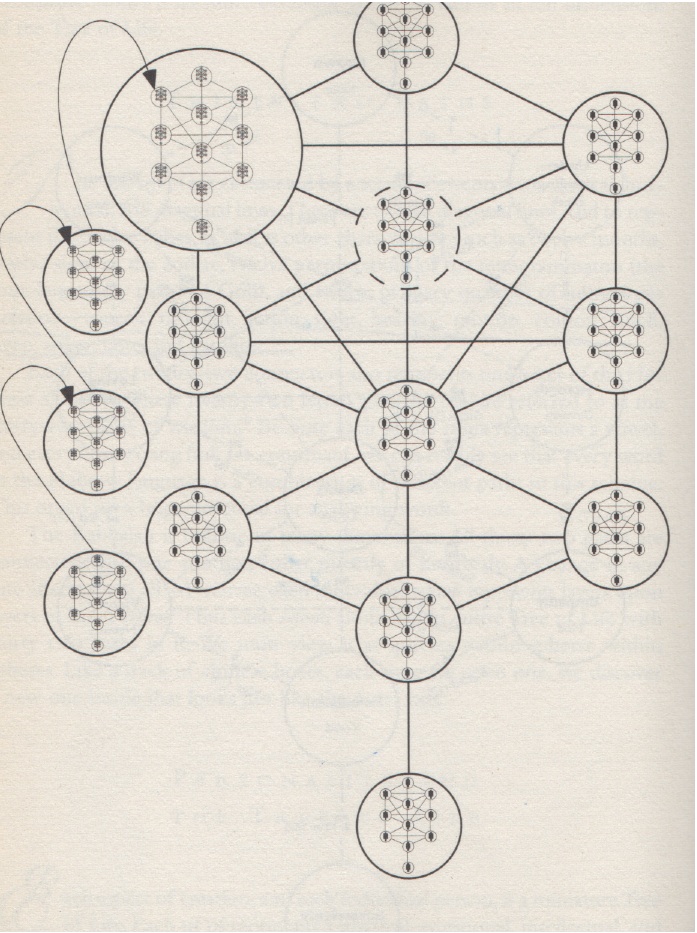
Tree of Life in Judaism refers to the symbolic tree of creation and to a paradigm of how to look at the world. The Tree is a set of stacked triangles that operate in triads: a characteristic, its opposite, and a balance point. They’re traditionally represented as spheres, called sephirot. The bottom seven are a strong and useful paradigm to use for solving any personal issue you’re wrestling with, aka getting out of a narrow place.

The first triangle is about unconditional love, discernment, and compassion. For an example, in relationship terms, think about: I love you madly forever; I need more boundaries, space, and time; Let’s work out something that’s good for us both. The  names of these spheres are chesed, gevurah, and tipheret.

The second triangle is about your life force: What energizes you? How and where do you aim it? What’s possible? In creative terms, it’s your Eureka! moment; your final draft/exam/signature/etc; and the possibilities that open up come from becoming an author/doctor/homeowner/whatever you’ve been striving to manifest. The spheres are netzach, hod, and yesod.

The seventh sphere is malkuth, the kingdom of here and now. This reality. How you pull all that powerful everything into the day-to-day of this life you’re living.

Week 1, which starts Tuesday April 15 at sundown, is a week of meditating on chesed. How you are open, generous, expansive, giving, and filled with love. Every Tuesday at sundown for the next six weeks is committed to each successive trait.

The holographic path has circuits of each sphere within the primary trait of the week (7×7=49 days). Omer-holoFirst you think about how loving you are, then why it’s good to have some boundaries, how to set them with grace,….and so on daily, through each trait. You can Google for daily meditation prompts from various perspectives, or ask and listen to your heart for questions as well as answers.

I recommend naming/numbering journal pages with the traits before you start, because it’s easy to slip behind and harder to get back in queue. This is a practice very worth doing, especially if you can identify one issue that you’ve been grappling with and feel like you’re stuck in a repetitive cycle that’s not leading you forward. You may not get to goal, but you will almost certainly get new insights and ideas about how to change your perspective and behavior.

So just for fun, starting bedtime Tuesday, think about how you are giving, loving, open, generous, and kind, in all the aspects of the Tree of Life, and see how it changes your now. Then work your way through each trait.

Got Your Goat: TorahCycle Acharei Mot


shoftimThere’s an ancient image of the scapegoat that comes from this week’s reading. Two goats are selected: one is sacrificed, the other cast into the wilderness bearing everyone’s sins.

While you might prefer your odds in the desert to the certainty of the blade, it’s considered an honor to be offered up, and a sign of shame to symbolically bear everyone’s evil doings. It also contains the infamous passage of Leviticus 18 so regularly cited by fundamentalists decrying “deviance,” though it also includes prohibitions against many things that are commonplace in contemporary life.

It’s so tempting to point fingers. To create an ”other,” a person or group on whom to project the feelings and traits we’re uncomfortable carrying around ourselves. Folks to aim at and talk about. Them not Us.

I had a troublesome employee once. Her mood was a seemingly permanent state of truculence and wheel-dragging. Her big tell was that she always said you instead of we. The rest of us were all other to her.

It’s hard to imagine snuggling up to the them’s once we’ve laden them with all our sins. Much easier to ship them out and far away to be sure our paths don’t cross.

A custom in the Middle Ages was to load the town’s outcasts (perceived deviants, mentally ill, and heretics) onto boats, and ship them down the river. That’s where the phrase “ship of fools” comes from. It’s also the title of Katherine Anne Porter’s book about a boatload of people fleeing Germany in 1939, adrift in the Atlantic as WWII erupts.

The scapegoats, the unwanted, the goats who escaped with only their skins and what they could carry. My own grand-parents were on such a boat. Two hours into Brazilian waters, or they would’ve been turned back to the charnel house of Europe.

I find it interesting that this reading comes so close to Passover, when the Jews themselves go into the wilderness. Perhaps liberated from Egypt more than thrust out of it. But still entering a dry, relentless place. One where you cannot hide who you are or what you do behind your possessions or social status. A place where every night you are cheek and jowl by your neighbors and their tents. Seeing their sins and having your own seen by them.

We don’t really see the folks we brand as Other. We lump them together in an amalgam of stereotypes (for example: greedy, anti-ecological Republicans; menacing, black men; raucous, irresponsible youth). And once we’ve slapped a label on someone, it’s pretty easy to focus on all they ways they are different from us. They are well on the way to becoming our goat.

But what if we had to look at the them in us? If we had to acknowledge that we too are capable of every form of sin? That our love is someone else’s deviance. And our piety is someone else’s blasphemy.

We might become a little more tolerant and understanding, and a whole lot more compassionate. Not casting folks as other or them is a good first step. If you want a bigger jump start towards a more compassionate world, practice saying we when you talk about anyone else and see how it feels.