Time Off For Good Behavior: Parshah Behar

Behar 2014Admit it, part of fantasizing a beach vacation is the vision of kicking back to do absolutely nothing without a shred of guilt. You’ve earned it. Sit. Stare. Dream. Drink. Nap. No obligations to do or be anything but be limp and relaxed.

The sad irony is how hard it is to gift ourselves that luxury.

Academics have a great job perk called a sabbatical. Teach six years, then get one off (though research and writing are implied). Farmers do something similar: letting fields lie fallow so the soil can replenish. What comes after is supposed to be richer and more nourishing than what came before.

It requires prep and planning. But if you do it right, life is easier. Time to do…..whatever you want! In ancient Israel, produce was free for all each seventh year. In addition, after seven cycles of seven years, the 50th was called a jubilee year. In a jubilee year, slaves are freed. All of them, freed; poof, chains gone.

When you think about your life, are there times you step back and see the changes? The big cycles and evolutions? Not just in yourself but also in those around you. Seeing young men/women you knew as toddlers or high-schoolers suddenly becoming married and parents?

We get used to life in the day-to-day. There may be changes and bends in the road, but sometimes they’re subtle. Perhaps you’re changing so slowly you don’t notice or create a moment of conscious choice, but when you look back they’re very clear. There’s obvious exceptions like birthdays ending in zero or five, graduations, weddings, and the like. But when do you give yourself a big chunk of time to look around and feel where you are on your path?

The past month I’ve been living in a construction zone. A long, tedious process of deconstruction and site prep, and now the glories of beautification. A change from old to new, with a fallow time in between.

I’ve needed it, and love the bursts of creativity it has engendered. But before that came discomfort. Watching how s.l.o.w.l.y. people work. Surrendering control. Abandoning the known. Forced quietude. Lots more being than doing.

For the record, my meditation practice includes lots of watching quietly. Wood stove in the winter; yard and sky in summer. Each season has a different tune and soundtrack. Different rhythms, but the basic message is the same: Feed your soul.

That’s the core message of this parshah: Take the time to feed your soul.

Maybe you can’t do it for a whole year. But take at least a little time each day to sit and watch. Listen, and give thanks. Work up to doing it one day a week, say, shabbat. Find special times during the year to yourself periods of quietude and perspective. To slow down and be present.

You’ll spend some of your mental energy in the past or future. But there will come a depth of welcome silence that will nourish and replenish you, if you let it.

Summer’s coming. Your jubilee moments may include a hammock, a hummingbird feeder, and or a gin and tonic. Whatever brings you quiet bliss, sit back and drink in the luxurious vibes of your jubilant now.

Holy, Holy, Holy: TorahCycle Kedoshim

Kedoshim-2014I’ve always love the synergistic connection between holiness and wholeness. Many of us embrace the holistic paradigm, seeing the whole as more than the sum of its parts. In theory, we should see ourselves as whole and holy (and each holy me as part of a whole and holy us). But more often we go though life scratching at our most annoyingly repetitive parts, and forgetting to use our better and stronger ones.

In a wonderful old Woody Allen image he’s clutching a piece of land, bequeathed him by his Russian serf father. It’s about the size of a cupcake. But it’s “his” and he holds it fiercely. Preserving that small patch is like tending your ego self in your current lifetime. It takes lots of work to keep it whole. And to make it healthy And, oh yes, to become holy, or at least holier than you might often feel.

This week’s reading is about paths to holiness. My lazy person’s gripe with Leviticus has always been that’s all about rules. Rules and regs. Laws and rules. Do’s and don’ts. And then more and more of them. Mostly they’re a great collection how to treat one another, moral compasses, aimed at creating strong and civilized community, though some feel arbitrary. There’s certainly lots to remember, let alone follow

As lapsed addict Nurse Jackie, Edie Falco admits to her sponsor, I have a problem with authority. Most of us do. We display varied responses, from rebellion to sucking up. Mostly we create complex, idiosyncratic dances to convince ourselves that our moral virtue is intact; then we scurry home with our paycheck, promotion, kudos, or whatever we needed from authority.

But what if, instead of being opportunities to rebel or feel guilty, those rules and regs were useful and helpful? If they created a path pointing exactly to the sense of grace that you seek?

Sure, they’re a minefield of chances to screw up. But what if you could envision a whole/holy you on the other side? Someone worth the effort of becoming. That’s the bait of before/after pics in weight loss and gym membership ads. Follow this holy carrot to a new and better you.

But what if by being just a little holier, you could actually become that you?

And what if, instead of being forced, ruled, or regimented into the process, you moved towards it. If instead of shirking or shying away from the path, you embraced the doing?

I have a friend who says, Don’t start a diet unless you’re really excited about it. What if you got excited about tending your small patch of you?

You know your stuff (which I call karmic homework) and I know mine. We probably have some good guesses (and probably some wrong ones) about each other’s. But what if we actually lived in a way that helped us get to where we wanna go? What if we followed the rules and they helped?

My lessons for the next phase of my life: Get excited about my karmic homework. Enjoy doing it. Do it well. Trust where it’s leading me. How’s that sound to you?

Day By Day: Counting the Omer

TOLEvery year in spring mystical Jews do a seven-week daily meditation. It’s multi-dimensional tour of aspects of divinity and self called The Counting of the Omer.

The practice stretches between two major sacred festivals. First, Passover, commemorating the exodus from Egypt (“the narrow place”), but more symbolically about leaving places of constraint. Think about a momentous life shift, like divorce, or a healing crisis. It’s about moving into a new and better you. Forty-nine days later comes Shavuous,  Sinai, being in the divine presence and taking it in through every pore of every incarnation.

They’re the book ends. Here’s how the middle works:

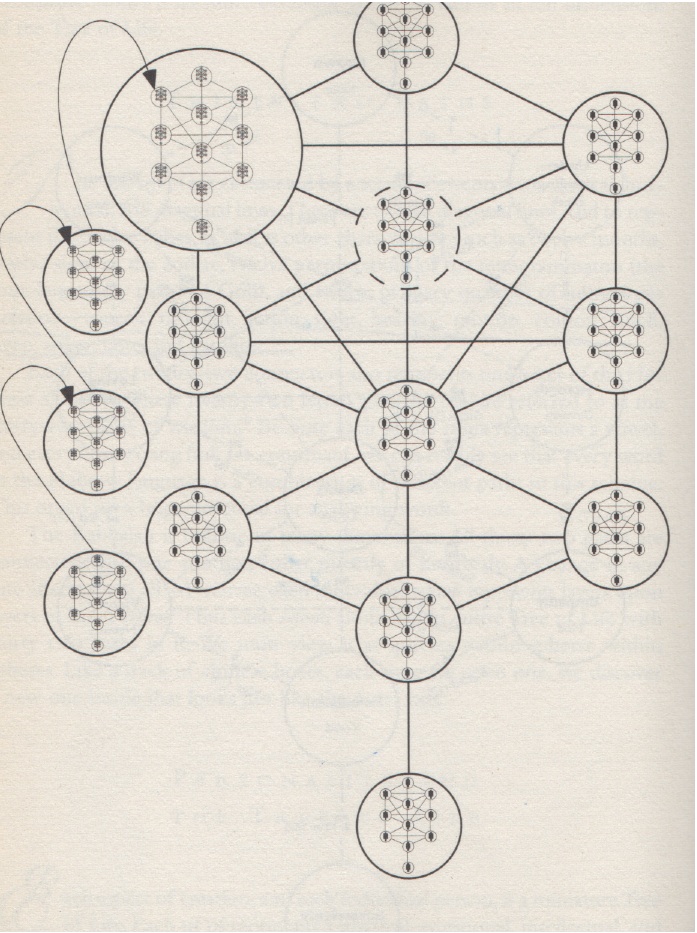
Tree of Life in Judaism refers to the symbolic tree of creation and to a paradigm of how to look at the world. The Tree is a set of stacked triangles that operate in triads: a characteristic, its opposite, and a balance point. They’re traditionally represented as spheres, called sephirot. The bottom seven are a strong and useful paradigm to use for solving any personal issue you’re wrestling with, aka getting out of a narrow place.

The first triangle is about unconditional love, discernment, and compassion. For an example, in relationship terms, think about: I love you madly forever; I need more boundaries, space, and time; Let’s work out something that’s good for us both. The  names of these spheres are chesed, gevurah, and tipheret.

The second triangle is about your life force: What energizes you? How and where do you aim it? What’s possible? In creative terms, it’s your Eureka! moment; your final draft/exam/signature/etc; and the possibilities that open up come from becoming an author/doctor/homeowner/whatever you’ve been striving to manifest. The spheres are netzach, hod, and yesod.

The seventh sphere is malkuth, the kingdom of here and now. This reality. How you pull all that powerful everything into the day-to-day of this life you’re living.

Week 1, which starts Tuesday April 15 at sundown, is a week of meditating on chesed. How you are open, generous, expansive, giving, and filled with love. Every Tuesday at sundown for the next six weeks is committed to each successive trait.

The holographic path has circuits of each sphere within the primary trait of the week (7×7=49 days). Omer-holoFirst you think about how loving you are, then why it’s good to have some boundaries, how to set them with grace,….and so on daily, through each trait. You can Google for daily meditation prompts from various perspectives, or ask and listen to your heart for questions as well as answers.

I recommend naming/numbering journal pages with the traits before you start, because it’s easy to slip behind and harder to get back in queue. This is a practice very worth doing, especially if you can identify one issue that you’ve been grappling with and feel like you’re stuck in a repetitive cycle that’s not leading you forward. You may not get to goal, but you will almost certainly get new insights and ideas about how to change your perspective and behavior.

So just for fun, starting bedtime Tuesday, think about how you are giving, loving, open, generous, and kind, in all the aspects of the Tree of Life, and see how it changes your now. Then work your way through each trait.

What If? : TorahCycle Tzav

KarmaRide 2013If you ran the world, how would it spin?

Everybody’s idea of happiness is different. (For some clues about how different, take a handful of buzzworthy quizzes.) Your idea of relaxation might be a four-star beach; your friend’s could be backpacking. You might aspire to being a musician or a CEO. Another’s dream is being a priest, a seeker whose job is to make ritual and to bless.

This reading tells us about the seven-day purification process for Aaron and his sons to become priests. But because I think this whole story is really about/for us, it suggests how to shed whatever’s keeping you from living not just holier but happier.

So, what would make you happy?

Most folks want to change something: from their bodies to a bad job, an unhappy relationship, or an unhealthy habit. We hope the payoff will be a better life, a good life. I’d like to expand the “good life” to be more than a satisfied sense of achievement and self-indulgence. I’d like it to include goodness in the moral and ethical sense.

One of my favorite bumpers stickers has always been If you want peace work for justice. Collectives, whether they’re tribes, nations, or political parties, tend to have goals that seem complicated. Individuals are easier. They mostly want to be happy. To not have to fret about safety, love, or money. To know the bills will get paid, that there’ll be food on the table, and that the house and kids are squared away. That there’s hope for the future.

Social equity breeds peace. Happy people are less likely to fight or kill.

If you decided to initiate yourself as a happier person, what would it take? Making and keeping vows? Making more time for your own priorities? Doing more for others? How would you do it and how will you know when you’re there?

The classic Buddhist answer is to shed desire. But for most of us there’s always one more nagging gimme, big or small, profound or silly.. The classic Jewish answer is similar: be happy with the life you’ve got. See everything that happens to you–no matter how undeserved or painful it may sometimes feel–as a chance to step up and show your faith.

Those may be the enlightened views, but small steps are a great start. Happiness with ourselves can amplify our caring and compassion for our friends and neighbors. And happier, more satisfied, people make this a better planet to hang out on.

We’ve all seen zillions of internet and email promises of Just 10 steps to [insert goal]. They generally include buying vitamins or pills, CDs, or books. But what if, as this reading suggests, taking seven days to focus on initiation could actually change you. Commit to doing any one thing, and actually stick to it. You might not become a priest, but what if you could become more/less  _____________?

What if you committed to one change for the next seven days, just to see how you’d feel on the other side? Nothing dramatic, just a single right step, repeated consistently. I’m going to do it, and pay good attention along the way. Please join me.

Day By Day: TorahCycle Mishpatim

Mishpatim-

This is the Year of the Grand Experiment. Living simply, with more emphasis on what matters to health, heart, and soul than to doing and stuff. Buying less,  and more consciously. Going eyeball-to-eyeball with my values, not just about money but with time, food, relationships, energy. Trying to make conscious choices in every dimension of life. Trying to live by guidelines and “rules,” notes that I wrote down last autumn, when I was contemplating what would make my life better, healthier, more creative, productive, and joyous.

The gifts that are coming towards me as I live by these rules are abundant. Some new, others I’ve sought for a long time. Some are delightful. Others challenging. When I do this experiment well, I hear them and if I hear them….That’s the rub, can I keep doing them?

I think the answer is Yes, because somewhere along the way I’ve moved from that old karmic dance routine of “one step forward, two steps back,” to its more evolved sister, two steps forward for every one back, sideways, or standing still staring into space wondering if I really can keep this process going.

This week’s reading has the great line We will do and we will hear (in contrast to a later one, We will hear and we will do). It’s a synergistic form of self-improvement. One that, like a childhood game, doesn’t matter where you jump into the circle. Just that you commit to doing. And keeping doing. Day by day.

This is the first reading in which we get lots of rules. Instructions for daily life: 613 in all coming our way, with 50+ here out of the gate. About everything from cooking to praying. Rules for behavior. But more importantly, an expression of values.

Sinai gave us the biggies, the Ten Commandments. These rules are the how-to manual for daily life.

When I work with people, coaching or problem solving, I’m always trying to get them to understand their values, and how those values influence and relate to their goals. What they’re striving for as well as their ethics and moral elasticity.

How we live daily life should be an extension of our values.

There’s a concept in Jewish mysticism of the big face and the little face: the face of the divine and our own. The little a reflection of the big. In the image, so to speak. There’s also the value of treating others as we wish to be treated.

If you cannot see yourself clearly, it will be harder to see another. Ditto to respecting, accepting, loving, having compassion for, and caring for yourself and others.

Take some time to think about your own values. Relationships, money, time, food, your body, and your spiritual practice. You can call them rules if you need a prod or an organizational tool. But in a more elevated consciousness, it’s about committing to living with ritual and with intention. About making the choice to elevate your actions by consciousness and awareness. Each choice, each moment. You may not see the face of God, but you can very clearly see your own.

Holy Wow: TorahCycle Yitro

Chukat

We all have forms of practice. Spiritually obvious ones like daily meditation or prayers, and more grounded forms like running or gardening. Leaving Egypt is like getting your K-6 certificate for doing a good job with your practice, so far. It’s a big deal.

So what do our guides do?  Give us a recess or two to figure out the lay of the land and the new us we want to be? Nope. We’ve barely got our feet on the trail and we’re catapulted to the holy of holies. A chance to seriously up our game.

Sinai imagery is of thundering sound from a cloud and lightning shrouded mountaintop. Hearing color. Seeing sound. Every sense askew from both message and delivery.

How about you? Do you want your next batch of lessons to arrive by knocking your doors off? Or do you prefer a process that guides you carefully, even gently, to greater insights and blessings? Do you want those lessons to deepen who you already are, or to challenge you to become different?

Torah talks about our physical senses being shattered open by revelation. The sacred geometry of mind and matter is complex and not under our direct control. But I get regular affirmations that what we think affects what happens in our lives, both for good and ill. We can’t make things happen, but when they come we can decide whether to welcome or run from them.

At its core, the Sinai experience is about deep kavannah, commitment and intention. Intention in a multi-dimensional, seven chakras at a time way: Yes. I’m all here and all in.

To reassure those who aren’t always so ready: in the story, the people close their eyes, cover their ears, and beg Moses to serve as their interlocutor. But for an instant, we each had a chance to say a profound Yes.

Buddhism teaches the importance of preparing for death. For the “go towards the light” moment between nows when you can shape your karma and consciousness. That moment’s also about intentionality and choice.

Mantra: Each choice matters, and impacts what happens next.

The big choice is choosing intention. This reading asks, What’s it gonna take to get your attention? A Holy Wow, a sweet arm around your shoulder, or something else? The universe has many ways, from kind to sly, even scary, of knocking on our doors. Some ways we neither invite nor welcome. But it also responds well to commitments that are deep and true. That align your holiest self with your deepest intention.

Get clear on what you want so you can start asking for it.

I welcome holy moments, but haven’t always accepted the responsibilities that accompany their invitations. As I age, I increasingly value the importance of listening to these messages, whether they come with trumpets or as whispers, as subtle hints or with clear instructions about what to do and how to live.

My advice: The next time you’re scared and want to cover your ears and eyes, instead embrace the idea that what’s happening is for your highest good. That it’s an opportunity to jump tracks, up your game, catapult yourself in the right direction. Then open your hands in gratitude and say Yes.


The Other Side: TorahCycle Beshellach

Beshellach

Sometimes you feel like you’re leaping towards liberation and other times the pace is glacial. But all roads lead to the sea, a metaphor of the last barrier which must be crossed, though the path ahead has vanished.

The story goes that everyone was standing on the edge, unsure and afraid, an angry army getting closer, until one guy jumps in. Only when the water hit his nostrils did the sea part.

That’s how ready and committed you need to be.

They emerge into a place called the Sea of Reeds. Still a sea, but with some purchase underfoot. Things returning to scale instead of a colossal tsunami on either side. And the reality of entering a new world. A new land, where everything’s unknown, both the gifts and the challenges. How nicely prophetic for the turn of the year.

Perhaps you too have made a shift in your life. Maybe not as big as getting out of slavery, but in your world just as important. Hooray if it was conscious. Even if not, think about where you were last year this time. And when you’d like to be next January. Find the vision you’ll need.

Mystical Judaism has the image/idea of klipot. Layers with which our holy spark gets covered and obscured. Think coats of pain that accrue from all your actions of denial and confusion, hesitancy or mistakes. They keep you just disconnected enough from your holiness that it can feel a little out of reach.

Now’s different. The turn of the year seems to peel away a few layers. Like you just had a loofa scrub. A little red and tender. But definitely refreshed and invigorated.

On the other side we’re like newborns. Full of potential, with our freedom, our spark, and our hope.

Take a minute to let the idea of “the other side” sink in. Big or small, you’ve made changes and committed to more. Your holy spark’s a bright ember. How’re you going to keep it glowing brightly?

What do the Israelites do on the other side? They dance and sing.

I’ve been listening to playlists put together by wise and knowing friends. One spins a beautiful refrain: What shall we do, what shall we do, with all this fragile beauty?

That’s the song of now. To decide what to do with your hard-won and fragile beauty. You can sign songs of triumph or songs of new desire. But also sing songs of hope and of commitment. Blow on your holy spark with a sure and encouraging breath. A breath of appreciation for past courage and of trust in your future.

There are moments in life when time slows. When we can get the perspective we need to move forward. That this reading comes at the time of light’s return is no accident. It encourages continuing work on our process. Asks us to look into the eye of God and then back at ourselves. To see and use our inner spark to light the way.

Whether you got here fast or slow, take a good look around. Remember this place of joy and possibility. Carry it with you as you embrace your next challenges.

Time’s Up: TorahCycle Bo


MiketzWay down deep in most of us is a hurting, a wounding to heart or soul, self-esteem or sense of self, that has brought us to this moment. It’s caused damage along the way, but also brought us to the knowing, both painful and liberating that we’ve reached the point of no return. It’s time to make a decision that will turn that painful it around, whatever your own special it is.

Remember the owwies of childhood, and your ambivalence about both wishing them gone and wanting to touch them? Change comes if you’re willing to dig deep enough to find and touch your inner sore place. You’ll know it by the way it feels: unresolved and always asking for something, perhaps attention, food, or love.

The source isn’t necessarily something that was done to you. It could have started when you failed to step up and take action or responsibility. It’s almost certainly something for which you have not yet forgiven yourself or another. Omission or commission makes no difference. What you most need to let go of  is its hold on you, on how it defines and organizes your story of life.

Confession. During a recent snow-enforced confinement I played Angry Birds (an addictive game of digital slingshot). There’s one bird on reserve (that acts like a neutron bomb) to use when you’ve failed once too many frustrating times at knocking down the targets.

It would be great to have such a ready tool for ourselves, when we’ve gotten stuck doing our emotional homework. Launch the mighty eagle; blow away all your failures and equivocation.

Our inner pharaoh has said Yes/No, Yes/No, Yes/No once too often. Time’s up. It’s time to fling that mighty eagle at yourself.

As silly as it sounds, some of my biblical imagery goes back to the classic 50’s movie, The Ten Commandments. After the last plague, the killing of the firstborn, the pharaoh who’s said Yes/No nine times prior stands holding his beloved son, his face a portrait of anguish, remorse, and regret. Nothing will make that boy alive again.

With luck you won’t need to go through such deep loss to make progress. But the stark and simple clarity that it’s time now to make changes is an important and compelling insight.

You cannot change the past. You can wish it undone, or pretend it was not so. You can’t erase the hurting. But you can transcend it. Can make your future different than your past. Use the energy you spent being angry, or fearing pain will happen again, to make changes, getting out of the narrow places that have confined and identified you for far too long.

The Jews are chased out of Egypt. You have the luxury of choice. To saying Yes to you and to joy.

We’re blessed this year to have this reading come at the transition between old year and new. A time when many of us make pledges about how we want to behave differently. If you make only one resolution, make it to live free of the pain of the past, and to live with greater awareness about what really matters to you in the year to come.

What’s It Gonna Take? : TorahCycle Va’eira

Va'eirah-2013After fruitcake and holiday sales is the New Year and everything that beginning represents. We start new cycles at other times, but the annual ritual of making resolutions is hard to ignore. Planning to get kinder, lighter, more focused or frugal…. Fill in the blanks with your own special challenges of this incarnation.

This week’s reading is about seven of the ten plagues. Various forms of discomfort and warning to deliver one message: Time and past time for change. P.S. The more you resist, the crappier it’s gonna get.

Moses and Pharaoh duking it out. Let my people go! Yes…No! Our own inner pharaoh knows this dance. We specialize in resistance, and are creative self-saboteurs, committed to keeping things as they are (no matter what or how much we say we want them to be different). We’re complicit with our oppression; with all the unhappiness that insight packs with it.

Why the push-pull? The list is tediously familiar: resistance from fear, guilt, laziness, shame, inertia. Stubbornness in every shape and style.

We each carry our own karma. Health challenges in one person manifest as emotional trauma in someone else. Family dysfunction, relationship problems, body shape and image, self-esteem. Pick a card, any card. All yours to wrestle with.

You know what works and what doesn’t. Know when you’re stuck, aimed in the wrong direction, faking it without real commitment, or otherwise avoiding what you say you want to do more or less of. Many of us spend huge amounts of time, effort, money, and enthusiasm making things worse instead of better.

A favorite line from the internet: I wish I weighed what I weighed when I decided I needed to lose weight. That kind of non-progress. Because knowing alone isn’t enough to make change happen.

This story, leaving slavery, is a very big deal. The first and biggest step towards freedom is overcoming resistance. Real change. Yikes!

So what’s it gonna take?

If we need to terrify ourselves with literal or metaphorical blood, darkness, frogs, or boils, then so be it. Hopefully you won’t do too much damage along the way. But it will likely be as annoying and persistent as buzzing flies.

Wouldn’t it be grand if we could don a biohazard suit for the duration, to prevent our emotional toxicity from leaking out? Maybe we’d change faster if we didn’t have others on whom to project our crap.

There’s a great John Gorka refrain: We’re all flashes in a great big pan and they’re turning up the heat. Our holy spark cooking in the heat of our collective, flawed humanity.

But throughout these goings on, this testing, we are slowly waking up. We’re learning something strong and powerful about who we are, what we require, and what we’re willing to sacrifice for what we most truly need.

So take some time during this year-end for reflection. Between the festivities and toasting, find a little quiet time to look at your thrashing, at all the ways you make life harder and more anxious for yourselves and those you love. Think about how to ease the process, and how to prepare for the changes that are coming. Keep that resolution and good will follow.

Step By Step: TorahCycle Lekh Lekha

LekhLekha 2013

Judaism is only part of my spirituality. But I genuinely believe that embedded in Torah is great insight and guidance for self-transformation and development. Most of us have embedded in our brains Bible stories and imagery from childhood. But deeper Torah raises lots of questions and challenges that can help you shape your now, and your becoming.

There’s an arc to the evolution of souls: your getting from creation to whatever’s your version of a promised land. Last week, the first thing Noah did after escaping annihilation was to get drunk and have sex. Ooops. Like eating a brownie an hour after starting a diet.

This week, the first thing we’re told is that Abraham is to leave the house of his parents and the land of his birth. He’s to set out for somewhere new and unknown. It’s a metaphor for walking away from what in your past defines you too closely. Whatever constrains your ability to grow and evolve. An instruction to leave behind your old habits. To prepare for the possibility of the new. To change without knowing what will come. But because you are ready to embrace the possibility and importance of making that shift.

Most of us have screwed up. Usually not just once. For our core issues – – love, food, money, or deeper — screwing up is probably familiar territory. Now’s a great time to begin to make a shift. Maybe not packing and calling u-Haul, but by doing something that feels potentially as important. Deciding to make a fundamental shift in the shape of your reality, your daily life, and your beliefs.

The first big step is self-scrutiny. The next, deciding what to change. Everything after is follow through. Aiming yourself in a different direction. Then continuing, step by step. Making your life about who you want to become, not who you have been.

In the beginning, the changes don’t have to be huge, or even consistent. Even doing one thing differently every other day will begin to increase your awareness. Consider every act a choice.

If you’re like most of us, you won’t walk in a straight line. You might go sideways, in circles, even backwards, for days, weeks, or longer. But each step is a step away from the old, a new step on your journey. Self-reinforcing and invigorating when you succeed.

It’s much easer to see other people’s paths. Your friends’, partner’s, or family’s. You have the perspective and vision to see quicksand two steps or two months ahead of them much sooner than they seem able to. You can see them looping around, not knowing they just veered way off course. (They can do the same for you.) It’s harder to see that clearly for yourself.

Life is such a fascinating and tenuous mix of insight and knowing, intention and awareness. We make greater progress when we add in faith. Believing in yourself is a great starting point.

That’s how change should begin. An energized mix of vision and focus. Sep by step it leads to manifesting. Anticipation and determination. Acknowledging the difficulty of change, but committed to trying. All your doing counterbalanced by the receptivity of an open heart.

Step by step.